
Most homeowners look at their scuffed, dull hardwood and immediately think replacement is the only path forward. That assumption is expensive, wasteful, and wrong. Refinishing reduces carbon emissions by 89% and energy use by 97% compared to replacing hardwood floors entirely. That’s a striking number, and it completely reframes how you should think about the floors already under your feet. In this guide, we’ll break down exactly what professional floor care means, why it outperforms DIY in every meaningful category, and which eco-friendly methods deliver the cleanest, longest-lasting results for your home.
Table of Contents
- What is professional floor care?
- Why choose professional over DIY floor care?
- Eco-friendly approaches in modern floor care
- Maintaining your floors post-professional service
- A smarter floor care strategy: Lessons from decades of experience
- Next steps: Bring professional, eco-friendly care to your floors
- Frequently asked questions
Key Takeaways
| Point | Details |
|---|---|
| Refinishing beats replacement | Professional refinishing offers 89% lower emissions and huge cost savings over new floors. |
| Eco-friendly products matter | Modern floor care uses safer, low-VOC finishes and dustless sanding to protect your family and the environment. |
| Pro care lasts longer | Expert methods and products give your floors deeper, more durable beauty than DIY. |
| Smart maintenance extends results | Regular cleaning with microfiber mops and felt pads preserves your investment after refinishing. |
What is professional floor care?
Professional floor care is a complete system of services designed to clean, restore, protect, and extend the life of your hardwood floors. It goes far beyond sweeping and mopping. True professional care includes a thorough inspection of the floor’s current condition, dustless sanding to remove old finish and surface damage, eco-friendly refinishing to seal and protect the wood, and deep cleaning treatments that get into the grain without damaging the material.
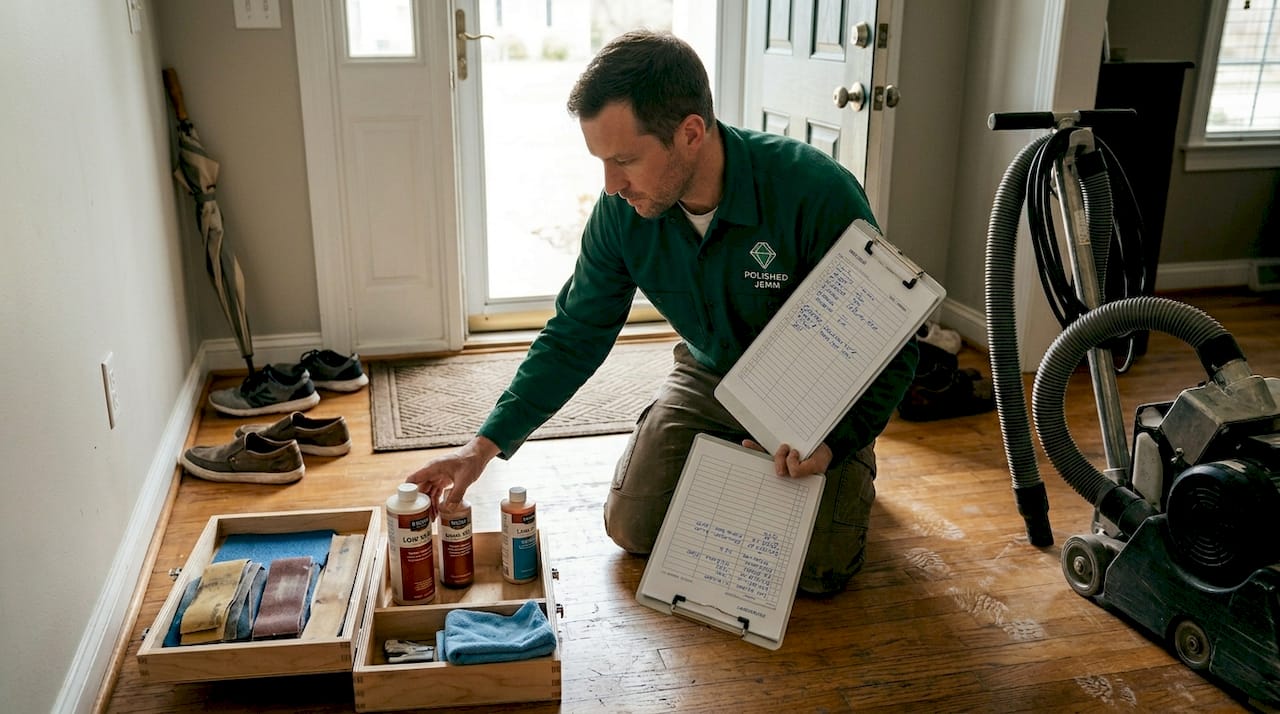
The contrast with DIY approaches is significant. When homeowners tackle floor maintenance on their own, they typically rely on store-bought cleaners, rental sanders, and finishes that were never designed for professional-grade results. The outcome is often uneven, streaky, or short-lived. Professional care uses trained technicians who understand wood species, moisture levels, and the specific finish that will hold up best in your environment.
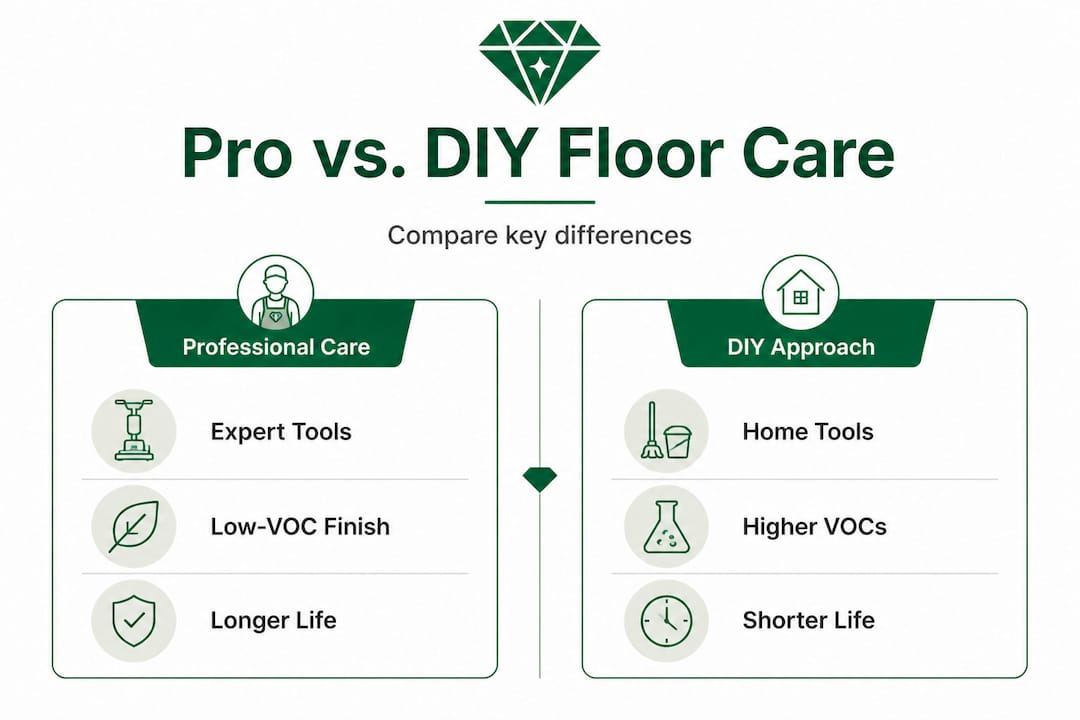
Here’s a comparison of what’s typically included in each approach:
| Service | Professional care | DIY approach |
|---|---|---|
| Floor inspection | Full assessment of damage and wear | Visual check only |
| Sanding | Dustless, precision equipment | Rental belt sander |
| Finish type | Low/zero-VOC, water-based or UV-cured | Store-bought polyurethane |
| Drying time | Fast-cure or same-day options available | 24 to 72 hours minimum |
| Indoor air safety | Minimal dust and chemical emissions | Higher dust and VOC exposure |
| Long-term durability | 7 to 10+ years with proper maintenance | 2 to 4 years average |
The range of services a professional company provides typically includes:
- Full refinishing: Sanding down to bare wood, repairing damage, and applying fresh finish coats
- Screen and recoat: Light scuffing of the existing finish followed by a new topcoat, ideal for floors with minimal wear
- Professional clean and buff: Deep cleaning followed by machine buffing to restore gloss without full sanding
- Protective coatings: Applying sealers or hardeners that resist daily wear, moisture, and scratching
- Epoxy coatings: For high-traffic or commercial spaces requiring an extra-durable surface
Pro Tip: Professionals use low or zero-VOC finishes along with dustless sanding systems, which dramatically improve indoor air quality during and after the job. If anyone in your household has asthma or allergies, this matters more than most people realize.
Understanding the refinishing benefits in full helps you see why this is an investment, not just a maintenance expense. You’re not just making floors look better. You’re extending their useful life by decades.
Why choose professional over DIY floor care?
DIY home projects have real appeal. You save on labor, you learn something new, and there’s a sense of accomplishment in doing it yourself. For most home projects, that logic holds up. For hardwood floors, the equation flips.
The risks of DIY floor refinishing are real and costly. An uneven sanding pass leaves visible swirl marks or ridges that only get worse once finish is applied. Rental sanders lack the precision of professional equipment and often cause more damage than they fix. Standard polyurethane finishes bought off the shelf contain high levels of volatile organic compounds (VOCs), chemicals that linger in your air for days and are especially harmful in enclosed spaces with poor ventilation.
Here’s what sets professional care apart in clear, practical terms:
- Expert diagnostics. A professional evaluates your floor’s wood species, existing finish type, moisture content, and the extent of damage before a single tool touches the surface. This prevents costly mistakes.
- Precision sanding. Commercial dustless sanding systems remove old finish evenly, without gouging the wood or leaving behind airborne particles that settle on surfaces throughout your home.
- Eco-friendly finishes. Modern professional finishes are formulated to cure fast, emit fewer chemicals, and create a harder surface than most consumer-grade options.
- Long-term durability. A professionally refinished floor holds up significantly longer, reducing the frequency of repeat work and protecting the integrity of the wood underneath.
- Cost efficiency over time. The upfront cost of professional service is often recovered within the first few years through avoided repeat treatments and delayed replacement timelines.
The environmental argument is just as compelling as the financial one. Refinishing professionally reduces CO2 emissions by 89% and energy usage by 97% compared to replacing the floor. That’s not a marginal improvement. That’s a fundamentally different environmental footprint. New flooring requires raw material harvesting, manufacturing, transportation, old floor disposal, and installation. Every one of those steps carries carbon costs. Refinishing skips all of them.
When you look at eco-friendly maintenance practices across the home improvement industry, floor refinishing consistently ranks as one of the highest-impact swaps you can make. For more detail on what a full refinishing project involves, the hardwood floor refinishing guide walks through the entire process from start to finish.
Eco-friendly approaches in modern floor care
The floor care industry has changed dramatically over the past decade. What used to mean strong chemical smells, days of waiting, and windows thrown open for ventilation now looks very different. Today’s leading professionals use methods that protect your family, your floors, and the environment simultaneously.
Modern eco-friendly techniques include:
- Water-based finishes: These dry faster than oil-based options, contain fewer harmful compounds, and produce a clean, clear look that shows off the natural grain of the wood.
- UV-cured coatings: Applied with specialized equipment, UV-cured finishes harden almost instantly under ultraviolet light, eliminating the extended dry time and off-gassing associated with traditional finishes.
- Dustless sanding systems: These commercial-grade systems capture 99% or more of fine wood dust at the source, preventing it from spreading through your home’s air and ductwork.
- VOC-free cleaning products: Used during deep cleaning services, these formulas are safe for children, pets, and anyone with respiratory sensitivities.
- pH-neutral maintenance solutions: Designed to clean effectively without stripping or degrading the protective finish layer.
The benefits for families go beyond just the immediate job:
- Safer indoor air during and after the service
- Reduced allergy risk from lower dust and chemical exposure
- Less downtime in the home, especially with UV-cured options
- No lingering odors that disrupt daily routines for days after the work is done
- Peace of mind knowing the products used meet current environmental safety standards
“Refinishing reduces energy use by 97% compared to replacement, making it one of the most environmentally responsible choices a homeowner can make.”
The smart care workflow that today’s top professionals follow is built around minimizing disruption while maximizing results. That means coordinating the right products, equipment, and techniques for your specific floor type and household needs.
Pro Tip: Before scheduling any refinishing job, ask your contractor specifically about finish options. UV-cured coatings allow you to return furniture to the room the same day in many cases, compared to the standard 24 to 48 hour wait for water-based finishes, or the 72 hours often needed for oil-based products. The difference in convenience is significant, and the quality of the result is equal or better.
For more practical guidance on everyday floor care decisions, the floor care tips resource from Polished JEMM covers a wide range of scenarios. And if you’re curious how eco-friendly outdoor cleaning principles translate indoors, you’ll find the parallels surprisingly direct.
Maintaining your floors post-professional service
Getting your floors professionally refinished is a smart investment. Keeping them in great shape afterward is what makes that investment pay off for the long term. The habits you build in the weeks and months after a professional service determine whether your floors look just as good five years from now as they do the day the job is finished.
Here’s a practical routine that actually works:
- Establish a weekly cleaning schedule. Use a microfiber mop every week to remove fine dust and grit before it can scratch the surface. Grit particles act like sandpaper underfoot, and they’re the leading cause of premature finish wear.
- Use only pH-neutral hardwood cleaners. Many household floor cleaners are too acidic or alkaline and slowly degrade the finish over time. A proper pH-neutral cleaner preserves the protective layer without breaking it down.
- Respond to spills within minutes. Water and hardwood are not friends. Even on finished surfaces, standing liquid can penetrate seams and cause swelling or staining. Wipe up spills immediately with a dry or lightly damp cloth.
- Install felt pads under all furniture. Chair legs, table bases, and heavy furniture all create concentrated point pressure that gouges finishes. Felt pads distribute that pressure and allow furniture to move without dragging.
- Use area rugs in high-traffic zones. Entryways, hallways, and kitchen areas in front of the sink take the most punishment. A well-placed rug captures grit before it reaches the floor.
Common mistakes that homeowners make after professional refinishing include:
- Over-wetting the floor during cleaning, which causes the wood to swell and eventually warp
- Using steam mops, which force heat and moisture directly into the wood and finish
- Ignoring small scratches, which, if left unaddressed, allow moisture into the wood grain and expand into larger damage
- Dragging heavy furniture without protection when rearranging rooms
- Using vinegar or baking soda solutions, which are popular home remedies but are damaging to hardwood finishes over time
Experts recommend scheduling refinishing every 7 to 10 years depending on traffic levels and wear patterns. For floors that receive moderate use and regular maintenance, a screen and recoat service every 3 to 5 years can extend the time between full refinishing jobs significantly.
For a complete walkthrough of how to protect hardwood floors through every season and lifestyle scenario, that resource covers specifics in much more depth. You can also find answers to the most common homeowner questions through the floor care FAQs page.
A smarter floor care strategy: Lessons from decades of experience
Here’s something we’ve noticed after years of working on floors across the tri-state area: most homeowners wait far too long. They see a dull floor and assume it’s cosmetic. They notice a few scratches and figure it’s not bad enough to address yet. Then one day they call us, and the floor that could have been beautifully restored with a screen and recoat now needs full sanding because the damage has gone too deep.
The uncomfortable truth is that floor care timing matters more than most people realize. Waiting until a floor looks terrible almost always means a more invasive, more expensive service. Acting at the first signs of wear means lighter work, lower cost, and a result that genuinely looks like new.
There’s also a mindset shift worth making. Most homeowners think about refinishing as a cosmetic decision. They’re focused on looks. But professional refinishing is not only about beauty. It offers dramatic long-term value and sustainability that goes well beyond appearance. A refinished floor protects indoor air quality by sealing the wood against dust accumulation. It maintains the structural integrity of the wood itself. And it avoids the enormous environmental cost of ripping out and replacing flooring that still has decades of life left in it.
We’ve also learned that eco-friendly methods aren’t just a nice-to-have for environmentally conscious clients. They deliver better practical results too. Low-VOC finishes cure harder and clearer than older oil-based formulas. Dustless sanding produces a cleaner substrate for the finish to bond to. UV-cured coatings mean your household gets back to normal faster. The green option is also the better option, and that’s not always the case in home improvement.
Reviewing the complete refinishing benefits helps homeowners make this case to themselves and their families when the question of budget comes up. The numbers make it clear that refinishing is not a luxury. It’s a responsible choice.
Next steps: Bring professional, eco-friendly care to your floors
If everything you’ve read so far resonates, the most important next step is scheduling a professional assessment before your floors need emergency intervention. A professional eye can identify wear patterns, finish degradation, and moisture concerns that you might miss entirely, and catching them early keeps your options wide open.
At Polished JEMM Floor Care, we’ve been serving homeowners across the tri-state area since 2014 with refinishing services built on craftsmanship, eco-friendly products, and honest communication. Whether you’re starting from scratch with understanding refinishing essentials, looking for a full walkthrough of reviving hardwood floors, or exploring our turnkey home floor services for a complete solution, we’re here to help you make the smartest decision for your floors and your family.
Frequently asked questions
How often should I refinish my hardwood floors?
Experts recommend refinishing every 7 to 10 years for best results, though floors with heavy traffic may need attention sooner. A screen and recoat service between full refinishing jobs can extend the timeline significantly.
Is professional floor care eco-friendly?
Yes, modern professional services use low-VOC or zero-VOC finishes and dustless sanding systems that dramatically reduce chemical emissions and airborne dust. Refinishing also cuts carbon emissions by 89% compared to floor replacement.
What’s the difference between professional and DIY floor care?
Professional care brings specialized equipment, expert diagnostics, and eco-friendly products that produce longer-lasting, safer results than typical DIY methods. Professional refinishing reduces CO2 dramatically compared to both DIY attempts and full floor replacement.
What daily maintenance does a pro recommend after refinishing?
Use a microfiber mop and a pH-neutral cleaner weekly, and protect all furniture contact points with felt pads to prevent scratching and preserve the finish between professional services.