
Most homeowners assume floor refinishing is straightforward. Sand the floor, apply some stain, slap on a coat of finish, and call it done. That assumption leads to some very disappointing results, peeling finishes, uneven color, floors that wear out in two years instead of ten. The truth is that what separates a breathtaking result from a regrettable one comes down to whether the contractor follows recognized industry standards. This guide breaks down exactly what those standards are, why they matter for your New Jersey home, and how to make sure your next refinishing project delivers floors that genuinely last.
Table of Contents
- What are industry standards in floor refinishing?
- How certified standards impact your floor’s longevity and look
- Screening vs full sanding: Decision logic and industry benchmarks
- How to ensure your refinishing contractor meets industry standards
- Maintaining your floors: Standards after refinishing
- Our perspective: Why industry standards are your floor’s insurance policy
- Choose certified floor refinishing for lasting beauty
- Frequently asked questions
Key Takeaways
| Point | Details |
|---|---|
| NWFA sets high standards | Choosing a contractor who follows NWFA standards ensures quality and lasting results. |
| Certified work prevents repairs | Industry-certified refinishing keeps floors beautiful and avoids costly fixes. |
| Screening vs sanding matters | The right method depends on your floor’s finish and damage, following industry guidance. |
| Maintenance is essential | Following industry-standard care after refinishing keeps floors looking new for years. |
| Vet your contractor thoroughly | Ask about certifications and industry standards to protect your investment. |
What are industry standards in floor refinishing?
Industry standards are not just a set of vague best practices printed in a pamphlet somewhere. They are specific, tested guidelines that define the correct way to assess, prepare, sand, finish, and inspect hardwood floors. These standards exist because hardwood floors are complex, and bad technique is easy to get away with in the short term while causing serious long-term damage.
The most important authority in this space is the National Wood Flooring Association, or NWFA. The NWFA is a recognized industry body that provides industry-accepted standards and training for wood flooring professionals across North America. Think of them the way you might think of a licensing board for electricians or plumbers. Their guidelines cover everything from moisture testing before sanding to the correct sequence for applying finish coats.
“Industry standards exist not to create paperwork, but to protect your investment. Every guideline has a reason rooted in how wood actually behaves.” — Polished JEMM Floor Care
For New Jersey homeowners, this matters because the region has real humidity swings between summer and winter. Wood expands and contracts with moisture, and a contractor who skips moisture testing is setting your floor up for cracks, cupping, or adhesion failures within the first year. Understanding the refinishing benefits only goes so far without knowing whether your contractor is following the rules that make those benefits possible.
Here is a quick look at the core areas where industry standards apply:
| Standard area | What it covers | Why it matters to you |
|---|---|---|
| Moisture assessment | Pre-sanding moisture readings | Prevents cupping, gaps, and finish failure |
| Sanding sequence | Grit progression from coarse to fine | Ensures smooth, blemish-free surface |
| Finish application | Coat thickness and dry time | Directly affects durability and appearance |
| Ventilation and safety | VOC control, respirator use | Protects your family during the process |
| Final inspection | Surface flatness, sheen consistency | Guarantees a professional end result |
When you look at refinishing services from a credible provider, you should be able to ask which of these standards they follow and get a clear, specific answer.
How certified standards impact your floor’s longevity and look
The gap between standard-compliant work and corner-cutting work is not always visible on day one. That is exactly what makes it dangerous. A floor that was improperly sanded or finished can look fine for six months and then start peeling, discoloring, or showing uneven wear patterns in high-traffic areas.
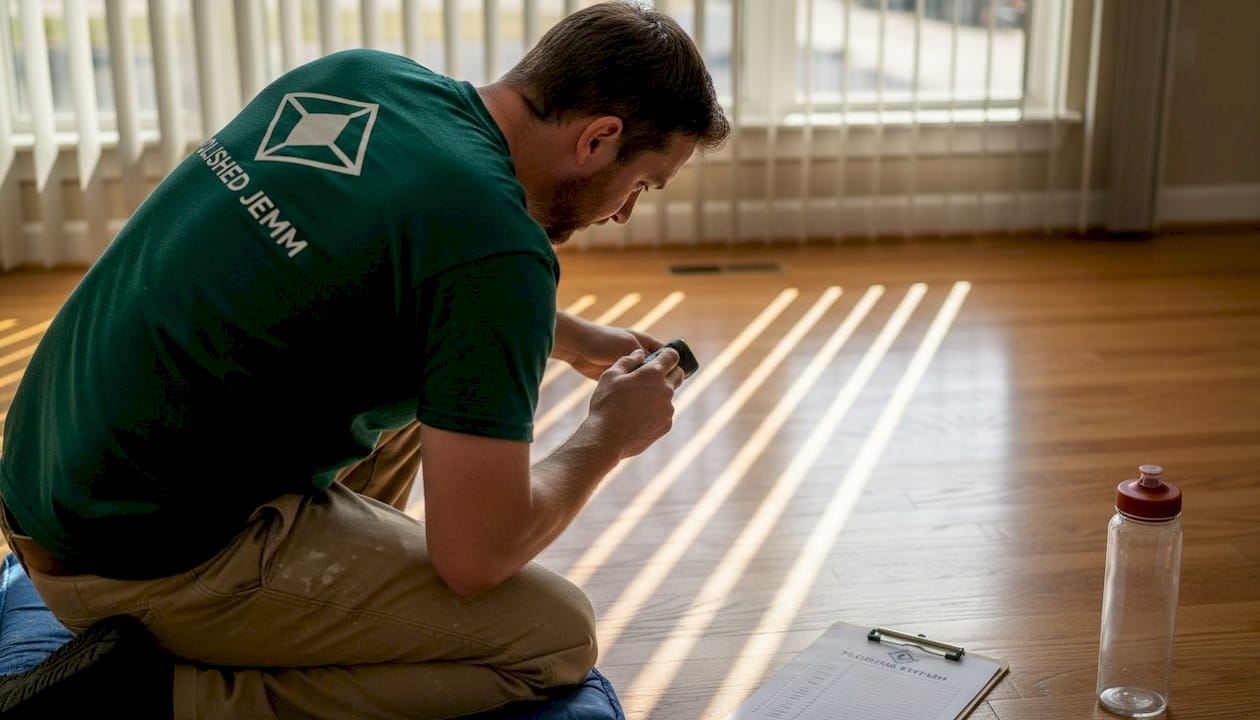
When a contractor follows NWFA standards, the Certified Professional programs they complete train them to make decisions based on your specific floor species, age, and condition. That is not generic knowledge you pick up watching videos online. It is tested, structured expertise that changes real outcomes.
Consider durability. A properly applied water-based or oil-based finish applied in the correct number of coats at the correct dry time intervals will typically last eight to twelve years under normal residential traffic. A rushed job where coats are applied too quickly will trap solvents, causing bubbling and premature wear, often within two to three years.
| Factor | Standard-compliant refinishing | Cut-corner refinishing |
|---|---|---|
| Sanding quality | Even across whole floor, no swirl marks | Uneven, visible scratches under light |
| Finish durability | 8 to 12 years average lifespan | 2 to 4 years before visible failures |
| Appearance | Consistent sheen, true color depth | Blotchy, raised grain, sheen inconsistency |
| Safety | Low-VOC products, proper ventilation | Chemical buildup, inadequate air quality |
| Repair costs | Minimal over 10 years | Potential full resand within 3 to 5 years |
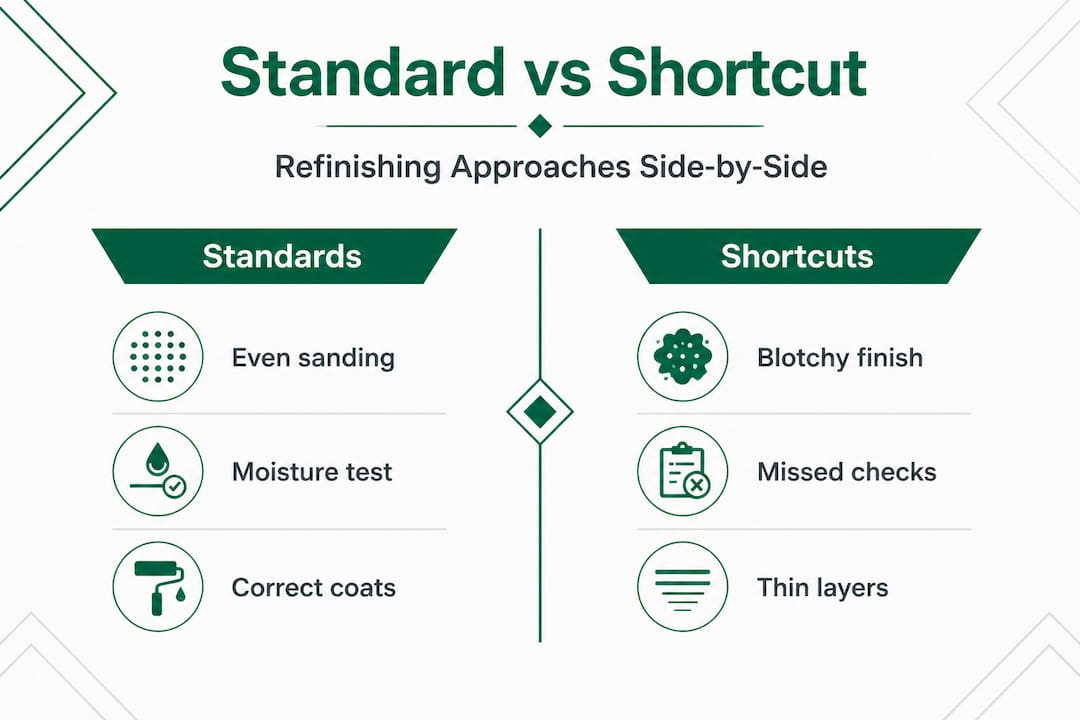
Statistic callout: According to industry data, improperly applied finishes account for the majority of premature floor failures in residential refinishing projects, most requiring costly repair within three years.
Understanding hardwood floor refinishing basics will help you recognize what a thorough job looks like during and after the process.
Pro Tip: After refinishing, check your floor under raking light from a low angle near a window. This reveals any swirl marks, missed spots, or uneven sheen that would be nearly invisible under normal overhead lighting.
Screening vs full sanding: Decision logic and industry benchmarks
One of the most misunderstood choices in floor refinishing is whether to screen and recoat or go through a full sanding. Homeowners often get a cheaper price for screening and assume it delivers the same results. Sometimes it does. Sometimes it is exactly the wrong choice for the floor in front of you.
Screening, also called buffing or abrading, scuffs the existing finish coat to create adhesion for a new topcoat. It does not remove old finish entirely. It does not cut into the wood itself. When done correctly on a floor in good structural shape with an intact, adhering finish, screening produces excellent results with minimal disruption and in less time.
Full sanding is a completely different process. It removes all existing finish and a thin layer of the wood itself down to bare wood. This is necessary when:
- The existing finish is peeling, flaking, or has failed adhesion in spots.
- There are deep scratches, stains, or gouges that reach into the wood fiber itself.
- The floor has been screened multiple times and there is no good finish layer left to abrade.
- The floor has been water damaged and shows cupping or crowning across boards.
- The homeowner wants to completely change the stain color.
“Homeowners should expect contractors to explain the reasoning between screening and full sanding using NWFA standards, not just offer the cheaper option without discussion.”
Contractors who follow industry benchmarks will conduct a visual inspection, often including a tape adhesion test to check whether the existing finish is still bonding properly to the wood. If the tape pulls up flakes of finish, screening is not appropriate. If the finish passes the adhesion test and the floor only shows surface-level wear, screening is the smarter, less invasive choice.
If you are in the northern New Jersey area and want to talk through which method fits your floors, the teams serving Mahwah refinishing and Franklin Lakes understand the specific wood species and floor ages common in these communities.
Pro Tip: Ask your contractor to show you the adhesion test result before they start work. Any professional who follows NWFA guidance will do this test automatically and be happy to walk you through what it means.
How to ensure your refinishing contractor meets industry standards
Knowing standards exist is only useful if you apply that knowledge when you actually hire someone. The vetting process matters enormously, and most homeowners skip it entirely or rely only on reviews and price comparisons.
Here is what a thorough vetting process should look like:
- Ask about NWFA membership or certification. NWFA Certified Professionals use current, accepted sanding and finishing practices. This is a direct indicator of commitment to quality beyond just marketing language.
- Ask how they assess moisture content. A contractor who does not mention a moisture meter before sanding is skipping a foundational step.
- Ask what products they use and why. Quality contractors can name specific finish brands and explain the choice based on your floor’s species and your household’s traffic level.
- Ask for a written scope of work. Standards-based contractors do not work from verbal agreements. They provide a clear outline of prep steps, products, coats, and dry times.
- Ask for references on similar projects. Floors in New Jersey homes from the 1960s and 1970s behave differently than new builds, and experience with your floor type matters.
Red flags to watch for include contractors who quote a price immediately without inspecting the floor, those who suggest sanding when screening would suffice (or vice versa without testing), and anyone who cannot explain why they are recommending a specific finish product.
Homeowners in communities like Oakland, NJ and Ramsey have access to contractors who know the local housing stock and can match their process to floors that have decades of history behind them.
Maintaining your floors: Standards after refinishing
Getting a great refinishing job is only half the equation. How you care for your floors after the work is done determines how long that investment holds up. The NWFA provides maintenance standards and homeowner resources that guide the right care habits for finished hardwood floors.
Here are the core maintenance practices that keep refinished floors looking their best:
- Use soft floor pads on all furniture legs. Felt pads prevent the micro-scratches that accumulate over time and dull the finish. Replace them every six months because grit gets embedded in them.
- Sweep or dust mop daily in high-traffic areas. Grit and sand are the biggest enemies of a floor finish. They act like sandpaper under foot traffic.
- Use only pH-neutral, hardwood-specific cleaners. Vinegar, steam, and general-purpose floor cleaners can break down finish chemistry over time. Use what your contractor recommends for the specific finish they applied.
- Keep indoor humidity between 35 and 55 percent. New Jersey winters create very dry indoor conditions. A humidifier protects against gapping and cracking.
- Place entry mats at all exterior doors. A significant portion of floor damage comes from abrasive particles tracked in from outside, particularly in winter when road salt gets into the mix.
- Address spills immediately. Water that sits on hardwood seeps into seams and can reach the wood fiber even through a sealed finish.
Recognize when it is time to call a professional again. If you see white haze in high-traffic areas, if the finish looks worn through in spots, or if the floor feels rough underfoot despite regular cleaning, it is time for a professional evaluation. Exploring home maintenance after refinishing and staying connected with the Polished JEMM blog can help you stay ahead of issues before they require a full resand.
Our perspective: Why industry standards are your floor’s insurance policy
After years of working on hardwood floors across northern New Jersey, we have seen what happens when standards get treated as optional. We have walked into homes where a contractor used the wrong grit sequence and left visible machine marks that came alive under sunlight. We have seen finish applied over incompletely dried stain because the contractor was trying to finish the job in one day against the manufacturer’s guidelines. The homeowner had no idea anything was wrong until the finish began to peel eight months later.
Here is the uncomfortable truth. Most homeowners cannot tell good work from bad work while it is happening. The damage shows up later, often after the original contractor is long gone and unreachable. Industry standards are not bureaucratic red tape. They are the accumulated knowledge of what actually goes wrong when shortcuts are taken, written into a code of practice that protects you.
We also push back on the idea that certified work is always more expensive. It costs more upfront when contractors use correct dry times between coats, which means more time on the job. But a floor done right lasts ten to twelve years. A floor done wrong may need a full resand in three. The true value of proper refinishing is not in the lower price on the invoice. It is in never having to write that check again in three years.
The single most valuable question you can ask any contractor is simple: “Can you walk me through the NWFA guidelines you follow for this job?” The answer will tell you everything.
Choose certified floor refinishing for lasting beauty
Understanding industry standards gives you real power as a homeowner. Now put that knowledge to work with a team that treats every floor like it matters.
At Polished JEMM Floor Care, we have followed NWFA-aligned practices since 2014, bringing that level of craft to homes across New Jersey. Whether your floors need a full transformation through our certified refinishing services or a quick refresh with our one-day screen and recoat, every project starts with a proper assessment and uses only eco-friendly, professional-grade products. We explain every step, follow the standards, and stand behind the results. Explore our homeowner refinishing guide and reach out to start your consultation today.
Frequently asked questions
What is the NWFA and why does it matter for floor refinishing?
The NWFA provides industry-accepted standards and professional certification for wood flooring contractors, making it the most reliable benchmark for quality workmanship in the industry. When your contractor references NWFA guidelines, it means their process is grounded in tested, peer-reviewed practices rather than personal habit.
How do I know if my contractor follows industry standards?
Ask directly whether they follow NWFA standards and whether they can explain their choice between screening and full sanding based on your floor’s specific condition. A contractor who cannot answer that question clearly is a contractor worth reconsidering.
What’s the difference between screening and sanding in refinishing?
Screening scuffs the surface finish to accept a new topcoat without removing old finish, while full sanding cuts through all finish layers down to bare wood for a complete reset. Understanding this decision logic from NWFA guidance helps you confirm your contractor is recommending the right method for your floor’s actual condition.
How should I maintain my refinished hardwood floors to uphold standards?
Follow NWFA maintenance guidelines: use soft furniture pads, sweep regularly, avoid harsh cleaners, maintain indoor humidity between 35 and 55 percent, and address spills immediately to protect the finish and the wood beneath it.