
Most homeowners look at their worn, scratched hardwood floors and immediately think two things: replacement or a weekend DIY project. Both feel logical. Both are usually wrong. Understanding why choose professional floor refinishing means looking past the upfront cost and seeing what you actually get: precision sanding, commercial-grade finishes, and results that last decades instead of years. This article breaks down the real benefits, the true cost comparison, and the specific conditions that tell you when professional expertise is not just helpful but necessary.
Table of Contents
- Key takeaways
- Why choose professional floor refinishing over DIY or replacement
- The professional refinishing process and how it preserves your hardwood
- Comparing costs and long-term value: refinishing vs. replacement vs. DIY
- When professional expertise is critical for your floor
- My take on why this decision matters more than homeowners realize
- Ready to see what your floors can become?
- FAQ
Key takeaways
| Point | Details |
|---|---|
| Professional finishes outperform DIY | Pros use superior-grade finishes unavailable to consumers, producing more durable and attractive results. |
| Refinishing costs far less than replacement | Professional refinishing runs $3 to $8 per square foot versus $12 to $25 for full replacement. |
| Most hardwood floors have multiple lives | Solid hardwood can typically be refinished 4 to 6 times across its lifespan. |
| Timing and conditions matter | The optimal temperature for finish curing is 65 to 75°F, making seasonal planning part of a quality job. |
| DIY carries hidden financial risk | Improper technique often leads to redo costs that exceed the original savings from going solo. |
Why choose professional floor refinishing over DIY or replacement
There is a reason professional refinishing exists as its own trade. It is not just sanding and slapping on a coat of polyurethane. The difference between a professional job and a DIY attempt shows up within the first year, sometimes the first month.
Access to materials you cannot buy at a hardware store. One of the most overlooked advantages of floor refinishing done professionally is the finish itself. Professional-grade finishes are not sold to consumers. They cure harder, resist scratching longer, and bond more cleanly to properly prepared wood. What you find at the big-box store is a consumer-grade version designed for ease of application, not longevity.
Surface preparation that actually works. Professionals use drum sanders, edgers, and buffer machines in a specific sequence. Each pass removes a controlled, even layer of wood. A novice with a rented sander can create gouges, wavy patterns, or uneven surfaces that become impossible to hide once the finish goes on. Incorrect sanding by novices risks exactly this, and fixing it costs more than the original project.
Repair capabilities beyond simple sanding. Professionals can fill gaps, tighten loose boards, replace individual planks where needed, and address minor cupping or crowning before refinishing. These repairs protect the floor’s structure and extend the time before any replacement is needed.
- Hairline cracks and minor gaps get filled with color-matched wood filler
- Squeaky boards can be secured during prep
- Edge damage from previous floor coverings gets addressed before the finish goes down
- Stains from pet accidents or water can sometimes be neutralized at the sanding stage
Aesthetic results that add real value. Refinished hardwood floors genuinely move the needle on home appeal and resale value. Buyers notice. The benefits of professional refinishing show up in both daily living and at closing time.
Pro Tip: Ask your contractor to show you finish samples on actual scrap wood, not a paper card. Colors look different on wood grain than on swatches.
The professional refinishing process and how it preserves your hardwood
Knowing what actually happens during a professional refinishing job changes how you evaluate quotes and timelines. It also helps you understand why the work takes the time it does.
-
Inspection and thickness assessment. Before any sanding starts, a professional measures the wear layer remaining on your boards. Solid hardwood flooring typically has a wear layer of about 3/8 inch above the tongue-and-groove. If previous sandings have brought that down too far, refinishing is no longer safe, and replacement becomes the conversation.
-
Progressive sanding passes. The process starts with coarse-grit sandpaper to remove the old finish, then moves through medium and fine grits to create a uniformly smooth surface. Multiple passes with specialized equipment are what separate a truly flat floor from one with subtle ripples that catch light in all the wrong ways.
-
Stain selection and application. Once the wood is bare, you choose whether to stain or go natural. Professionals apply stain evenly across the entire floor and let it penetrate before wiping. Uneven application creates blotchy color that no amount of topcoat will fix.
-
Finish coats and cure time. Most professional jobs apply two to three coats of finish, with light screening between coats. The final coat needs proper curing time before the floor can handle furniture and foot traffic.
-
Environmental controls. Optimal temperature for even finish curing sits between 65 and 75°F. Professionals account for humidity levels in your home during this phase because a finish applied in high humidity will not cure cleanly and can cloud or peel.
“Refinishing preserves the original wood character, something that simply cannot be replicated with new flooring, particularly in older homes where the grain, patina, and species are part of the building’s history.” (Source)
Comparing costs and long-term value: refinishing vs. replacement vs. DIY
This is where the financial picture gets concrete. Numbers make decisions easier.
| Option | Cost per sq ft | Lifespan of result | Key risk |
|---|---|---|---|
| Professional refinishing | $3 to $8 | 7 to 10 years per cycle | Minimal if contractor is qualified |
| Full replacement | $12 to $25 | 25 to 50 years total | High upfront cost, loses original wood |
| DIY refinishing | $1 to $3 (materials) | 2 to 5 years or less | Damage, poor finish, redo costs |
Refinishing costs 60 to 80% less than full replacement when you factor in demolition, disposal, and reinstallation. For a 1,000-square-foot floor, that difference can be $15,000 or more.
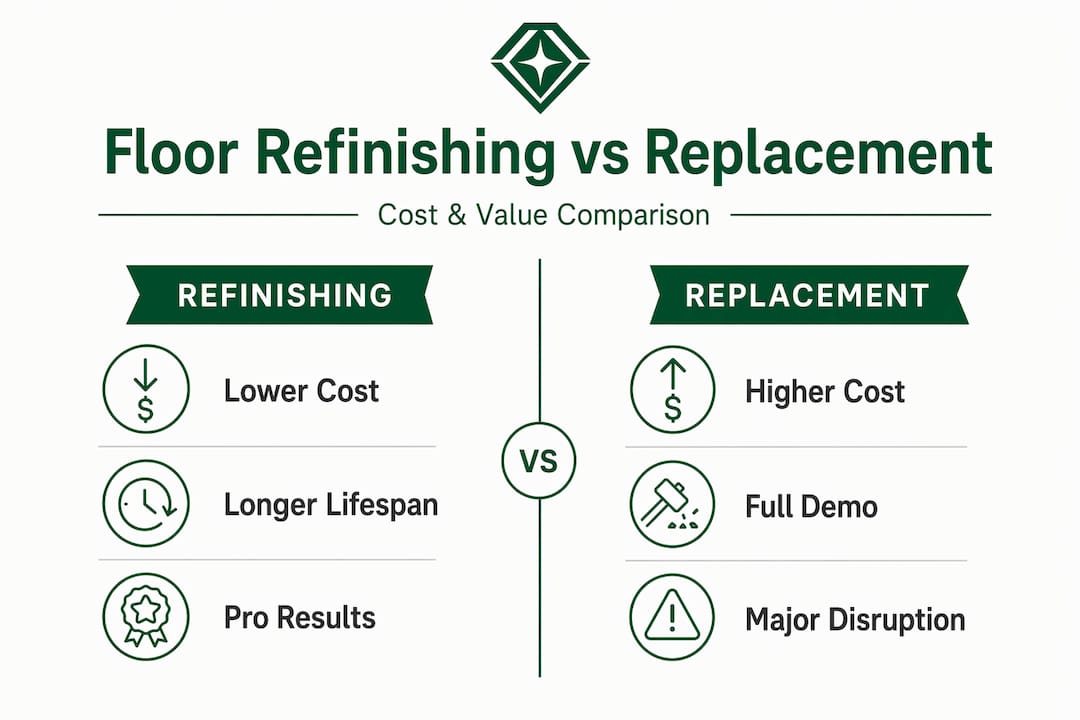
The DIY row deserves extra attention. DIY refinishing risks include improper sanding, incompatible finish products, and surface prep mistakes. The result is often a floor that looks worse than before, or one that needs professional correction within two years. The redo cost typically wipes out the initial savings and then some.
Most solid hardwood floors can be refinished four to six times across their lifespan. That means a 100-year-old oak floor in a Victorian home can likely handle two to three more professional refinishing cycles before any discussion of replacement. That is a significant financial asset sitting under your feet.
Replacement makes sense in specific situations: severe structural damage from water, subfloor rot, too many previous sandings leaving inadequate wear layer, or a homeowner wanting to change wood species or layout entirely. Outside of those conditions, refinishing wins on economics every time. You can review cost factors for tri-state homeowners to get a clearer picture of what your specific project might run.
When professional expertise is critical for your floor
Not every floor needs the same level of work. Knowing how to read your floor’s condition is the first step toward making a smart decision.
Signs your floor can be refinished:
- Surface scratches and scuffs that have not penetrated through the finish into the wood
- Dullness and wear patterns in high-traffic areas like hallways and kitchens
- Minor staining that may sand out or respond to bleaching
- Color fading or finish flaking with structurally sound boards underneath
Signs you may be closer to replacement territory:
- Boards that flex or bounce when walked on, indicating subfloor or fastener issues
- Deep cupping or crowning across multiple boards from long-term water exposure
- Gaps wider than a credit card between boards that have not responded to seasonal changes
- Grey or black staining that has penetrated deep into the wood grain
Pro Tip: Hold a single light source close to the floor at a low angle and look down the length of the boards. This “raking light” technique reveals surface irregularities, previous bad sanding jobs, and cupping that is invisible under standard overhead lighting.
The importance of professional floor refinishing becomes most obvious during the assessment phase. A qualified contractor evaluates wear layer thickness, checks for previous sanding marks, tests moisture levels, and identifies structural issues before committing to a plan. You cannot make any of those determinations with a visual inspection alone.
Timing your project within a broader renovation also matters. Refinishing should happen after drywall work, painting, and cabinetry installation but before base moldings go back on. Scheduling it last in a renovation sequence, when doors are being opened and closed frequently, creates humidity swings that affect finish curing. Professionals who plan renovation sequences properly protect both the finish and the surrounding work.
My take on why this decision matters more than homeowners realize
I have watched homeowners spend a Saturday on a rental sander and come out on the other side with floors they are embarrassed to show. Not because they were careless. Because the skill gap between consumer-grade equipment and professional technique is genuinely large, and nobody tells you that until after the damage is done.
In my experience, the homeowners who regret refinishing decisions almost always regret going cheap or going solo on a job that looked simpler than it was. The ones who feel great about their floors a decade later? They hired people who do this every day.
What I find most overlooked is the value of the initial consultation. A professional can walk your floors in fifteen minutes and tell you things about their condition that would take a homeowner weeks of online research to piece together. That assessment alone is worth the call, before any money changes hands.
The importance of hiring professional floor experts is not about gatekeeping a skill. It is about protecting a real asset in your home. Hardwood floors that are properly maintained can outlast the house’s other renovations by decades. Floors that are over-sanded, under-prepped, or finished with the wrong products become a problem you will pay to fix twice.
Trust the process. Trust someone who has done it hundreds of times. Your floors will thank you.
— Jim
Ready to see what your floors can become?
At Polishedjemmfloor, we have been refinishing hardwood floors across the tri-state area since 2014. Every project starts with an honest assessment, not a sales pitch. We use eco-friendly, commercial-grade finishes, and we stand behind the results.
Whether your floors need a full sand-and-refinish or a one-day screen and recoat, our team brings the equipment, the experience, and the attention your home deserves. Explore our hardwood refinishing services to see what is possible, or dive into our homeowner refinishing guide to understand exactly what to expect from the process. Contact us today for a free estimate.
FAQ
How much does professional floor refinishing cost?
Professional refinishing typically costs $3 to $8 per square foot, compared to $12 to $25 per square foot for full replacement. Exact pricing depends on floor condition, square footage, and finish type.
How many times can hardwood floors be refinished?
Most solid hardwood floors can be refinished four to six times over their lifespan, provided enough wear layer remains above the tongue-and-groove joint.
Why hire a floor refinishing expert instead of doing it yourself?
Professionals use commercial-grade equipment and finishes not available to consumers, and their technique prevents the uneven sanding and poor surface prep that commonly ruins DIY attempts. DIY refinishing risks often result in redo costs that eliminate any initial savings.
What is the best time of year to refinish hardwood floors?
The best conditions for refinishing are temperatures between 65 and 75°F with moderate, stable humidity. Spring and fall typically offer the most consistent conditions in most U.S. regions.
Does refinishing preserve the original character of my wood floors?
Yes. Professional refinishing preserves original wood character including grain, patina, and species, which is especially valuable in older homes where that character cannot be replicated with new materials.